Wednesday, August 25, 2010

How fi get tings finish pon di Rock!

(Or: How to get things done in Jamaica)

So I think I'm getting my rhythm here. A quick recap of today's events in town (which may seem like a long and pointless story), and how they relate to my Peace Corps experience as a whole.
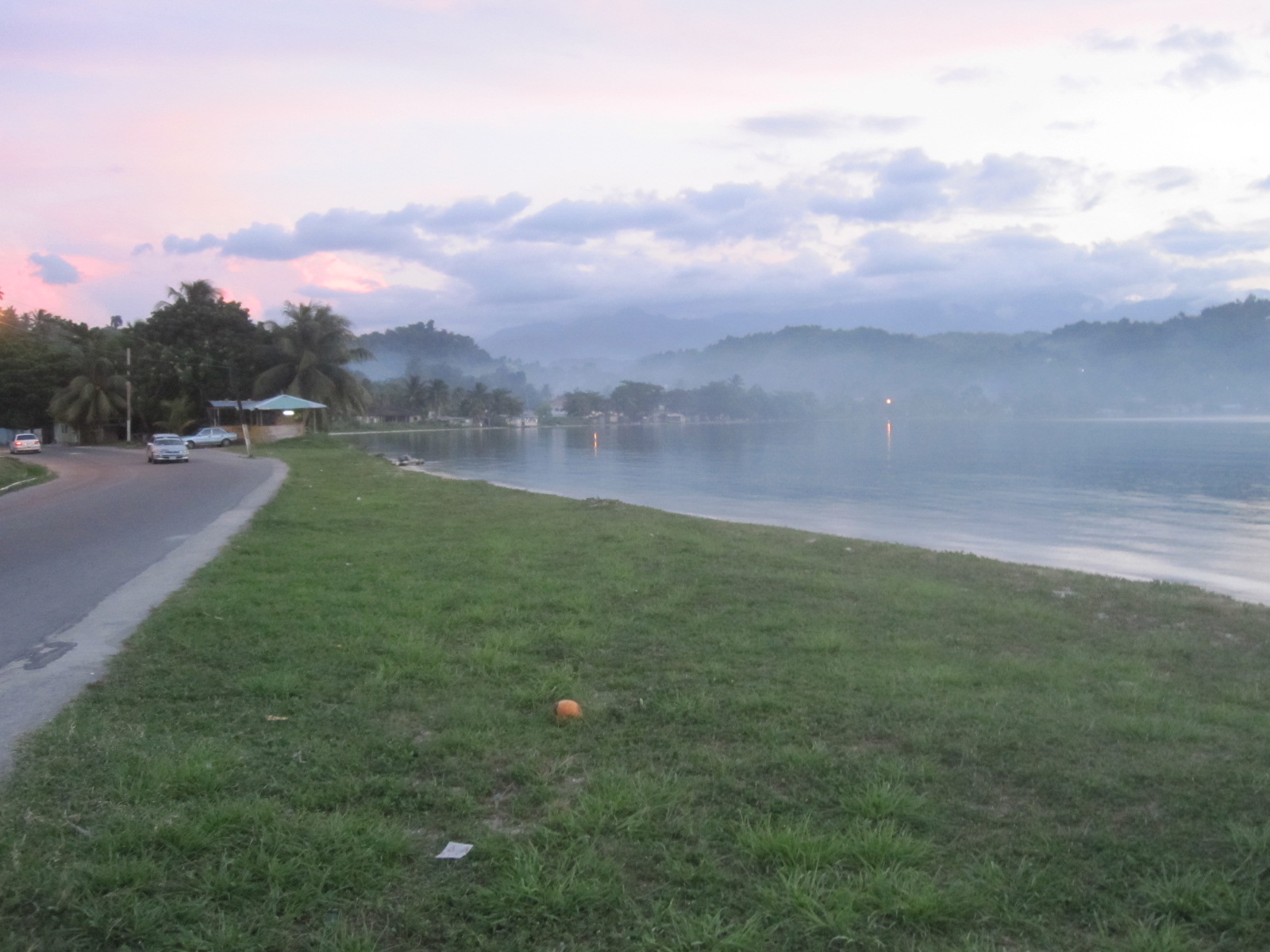
Smoke from brush fires cast a dusk fog over Port Antonio yesterday.

I went into town today to get a whole heap of things done, but also to purchase and use one important item: a 5/8" drill bit. Something that looks like this:


I need this drill bit for my winemaking. When making wine, the yeast consumes the sugar from the fruit and extra sugar you add to the must (a name for unfermented wine). The yeast also expels alcohol and carbon dioxide. For cost and other reasons, I brew in plastic buckets, similar to paint buckets with lids. We want the alcohol to stay in the bucket, but we want the CO2 to escape so the pressure doesn't build up inside the bucket. We can't simply leave the bucket uncovered either, because oxygen will spoil the wine, so we drill a small hole, put a rubber bung in, and then then place an airlock in the bung.

Bung and airlock.

This allows CO2 to escape without letting oxygen back in, and is how nearly all wine and beer is made around the world. Generally speaking, this is not the way wine is made in Jamaica, as everyone has their own methods and traditions, but I'm here to try to make winemaking professional, efficient, sterile, and more cost effective. At fist, I had the airlock fixed to the bucket through a small drill hole with masking tape which was failing to provide an airtight seal. Now, to put the airlock on the wine bucket correctly, I need a drill bit to insert the bung. Yesterday I bought a 3/4" wood bit from the hardware store, but after I drilled the hole I realized it was too large and the bung will not be able to form an airtight seal. Luckily I was able to return it, saving me the $350J I spent.

Not an airtight seal.

So today, I set out to buy a 5/8" drill bit. However, this is an item that isn't commonly used, and as a result it is an item that is not commonly stocked in Jamaican hardware stores. Another thing about Jamaican hardware stores, or at least most of them, is that you cannot simply walk up and find what you're looking for. The first hardware store I went to had a wall with steel cage separating you from the staff and the hardware, and three lines. One to tell them what you're buying, one to pick up your hardware, and a third to pay for it. I waited in line 10 minutes in the first, only to have the woman tell me she didn't know if they had it and to wait in the second line to see. 5 minutes later a man came up and I told him I needed a 5/8" drill bit. Or, specifically, I said "Excuse, do you have a five eighths drill bit?" To which he replied "Me nuh undastand." A Jamaican next to me translated, and said "You have wan five eight drill bit?" This was understood and the clerk went to search for it while I stood thoroughly confused as to why I wasn't understood the fist time. While he looked for the bit, I had to repeatedly say which size I was looking for. "you wan 3/16 inch?" "Nuh, Mi a look fi five eight bit, 3/16 kyan work!" "Wi av 5/32 bit" "Nuh, you av 5/8?" Eventually the clerk sort of wandered off and started talking to another customer. I interrupted him and asked "So, you don't have the bit?" "Nuh, wi no av it." I left frustrated.

By this time I was almost late for a meeting with my new supervisor and a Peace Corps staff, so I left without going to any of the other stores. The meeting went well, and before I left my supervisor asked me how the wine was coming, so I explained how I needed the drill bit. She asked what stores I went to, and I told her the two I visited, and she rattled off three other stores and their phone numbers from memory (this woman is so connected to the town and businesses she could probably tell me what the mayor's favorite ice cream flavor is). On my way out, her husband asked me what I was looking for and I explained. He called downstairs where a contractor was putting up grills (security bars over windows and doors) to see if he had a drill bit I could borrow, but he didn't.

I walked to the first store she mentioned, and found a 1/2" machine bit. When I compared it to the bung, I realized it would work, however the machine bit had a 1/2" shaft as well, which would probably be too wide for the drill I was planning on using. A wood router bit would be better suited for the job since the shaft is smaller and would easily fit into any drill, but still I bought the bit since it was this difficult to find anything that would work.

Sure enough when I got back the bit was too large for the drill. I remembered seeing a drill press by one of the metalworkers on the main road, and took the bit and the bucket lid to see if I could use the press just for the one hole. On my way to the shop I ran into my landlady's son, who introduced me to the blacksmith and asked on my behalf if he could drill a hole in the bucket lid for me. 15 seconds later I had my lid with the right size hole, huzzah! I talk to my landlady's son, and he tells me how great a guy the blacksmith is and what good work he does. Then I remembered that Jerry, another volunteer, needed to find a welding machine he could use for his students in the welding and fiberglass repair course, so I started talking to the blacksmith. The conversation went something like this:

"Thanks again for letting me use the drill press. I'm a Peace Corps volunteer, and I notice you have a welder. There's another volunteer who is teaching some students, and I was wondering if they could use your welder?"
"No, no, no, I'm too busy! I can't manage that."
"Yeah yeah, mi hear you. Hey, those grills you make look really nice, if I need you fi mek up somtin can I come back so?"
"Yeah mon! Anytime!"

Now, I didn't fully realize what happened in that conversation until afterwords, but that short bit of dialogue really encompassed the difficulty of volunteer work in Jamaica. Before we talked, the blacksmith did me a seemingly small favor that ended up saving me a whole mess of a headache, and he did it for free. This is rare, and I knew I just found a great resource I want to keep on good terms with for the time that I'm here. I pushed a bit too far however when I asked for his help with the welding students. Anytime I walk past his shop, he is working. This means any time he spends working with students would be time and money he is losing, so I should have known what his response would have been before I asked him. When I was walking back with my supervisor's son, he told me "He's a good guy, but he knows whenever people ask for help with things like this it keeps growing and growing, and it's a big headache and he looses a lot of money."

This also relates to an interesting phenomenon: there is no tipping in Jamaica, or at least there isn't outside of the tourist and uptown Kingston establishments. When you seek services, you are given a set price, but it shouldn't be more. The flipside of this is that everything has a price, including things which in America would be assumed included in the price. A Jamaican comedian we listened to during training had a bit where "You know here you can see a shop, and it has a sign that say 'Chicken sandwich $200, with bread $250. With Chicken $350." With the blacksmith, I wanted to ensure that he knows I am not expecting him to do everything for free, so I made sure he knew I appreciated his help and would be coming back soon (I have a bike that I would like a basket made for). After I said this, he perked up, aware that I wasn't just expecting freebies from him.

On the way back to the school I was stopped by the contractor working on the grills, who wanted to know if I got what I was looking for. I held up the bucket lid with the hole drilled in it, to which he replied simply "Yeah mon!" I like that even though he didn't know who I was or what I was doing, he was happy that I got what I was looking for. I had a similar exchange with the lady who runs the shop upstairs, happy that I got what I was looking for but probably just humoring me when I explained to her why it was so important.

By the time I got upstairs to the school I was drenched in sweat, having walked back and forth in town all day. But, I was able to put the lid on the bucket with the fermenting wine and attached the airlock, making that batch of wine safe from being contaminated by flies or bacteria. Anyone looking at that bucket before with the airlock attached with masking tape and the same bucket after with the right size drill hole and bung would probably not notice or care about the effort that went into getting that damn hole put there, or the importance of that damn hole and airtight seal, or what the whole experience says about life here, but hopefully now just a few more will.

So overall, I needed to drill a hole, a relatively simple operation. In the process I got frustrated with a security-crazy customer-unfriendly store (which many Jamaicans deal with on a daily basis), used local knowledge and resources to find what I need (but not necessarily what I went out to find initially), explored the interrelationships between volunteerism, capitalism, and altruism, and enjoyed a bit of local camaraderie for my small success towards my goal of creating attainable small business ventures for Jamaican farmers and prospective winemakers. Honestly, this was one of my most successful days, and if I can keep this up who knows what I'll be able to accomplish with my counterparts.

Tuesday, August 3, 2010

Portland: The Other Jamaica

It's been a wild couple of months...so I'll do my best to summarize how I went from engineering in Spanish Town to making wine in Port Antonio.

It all started with Hurricane Dudus. Because of the events around Kingston, Peace Corps felt it was best to move me out of my community in Portmore and away from the corporate area completely (this includes Kingston, Portmore, and Spanish Town, where I spent nearly all of the last year and a half). I got the call at 9:00 a.m. and was out the door by noon. I haven't been back since, but I was able to call all my community members and tell them I'll come back to visit as soon as I am able.

While talking to staff in the months leading up to my move, I mentioned that I'm interested in winemaking and "agro-processing"; preserving fruits and produce by making jams, dried fruit, salsa, and other products. Some of the Peace Corps staff knew of an opportunity to do this in historic Port Antonio, Portland, on the North-East corner of the island, about 2 hours through the mountains from Kingston. Soon after I was headed to my new home.

Port Antonio, or "Porty" as the busdrivers will yell, is the capital of Portland Parish, and a beautiful little town with a marina and a few resorts along the North coast road. Compared to my previous site, it's tiny, wet, green, lush, and overall just amazing. My first few months here were spent setting up my assignment, working out what I hope to accomplish with this "agro-processing" idea. I was paired up with Mrs. Smart, who runs a nationally certified vocational school and offers courses in nursing, hospitality, and food preparation. Already having a full kitchen facility and experience in food education, it was a great fit, and I was off to work.

After talking with Mrs. Smart and many local farmers, produce sellers, and businessmen, we developed a framework around teaching simple food preservation techniques that are easily accessible to farmers or any interested person. Using common fruits such as mangoes, pineapple, guava, and others, the supply cost for the preserves should be minimal. For example; during mango season, there are literally thousands of mangoes rotting on the ground. "Stringy" or "Common" mangoes, while sweet, are very fibrous and not attractive to the produce market. However, if they were fermented, the fibers should settle or float out to be discarded. To test this theory, I used some leftover winemaking equipment to start a two gallon batch of mango wine at the school. Mrs. Smart helped, along with her husband and son.

I also ordered some additional equipment to test and further refine my winemaking skills and to adapt them to my new tropical climate. My hope is to test all different kinds of mangoes, pineapples, guava, and other fruits, setting up dozens of fermentations to determine which combination of fruits and additives will yield the best wine. After enough testing we will develop recipe and training guides and eventually start up our own agro-processing training school. Winemaking will be just one avenue, in addition to preserves and fruit drying, which I will also be experimenting with to develop local recipes and training guides. The ingredients and equipment that cannot be found easily on the island we will import and package into "wine kits" to sell to farmers at an affordable price that will include everything needed to start several batches of wine yielding hundreds of bottles. Anyone interested in making wine will be able to come to the school for training, recipes, and equipment.

The last few months have been some of the most intense in my life. I moved and re-moved, traveled all over the island for meetings and trainings, and had to adjust myself to an entire new community. Luckily I have the benefit of a Peace Corps staff that was helpful and understanding, Jamaicans who are welcoming and friendly, and a few other volunteers who are just great to have nearby. I will miss my former coworkers at Food For the Poor, however I am still in contact with them and hope to continue working with them in an auxiliary role.

Every day here is a new face, a new sight, new smells, new sounds. What comes next for me, I am excited to say I have no idea.

Tuesday, May 25, 2010

Old Capital

Let me start out by saying, with everything in the news recently, I and my fellow peace corps volunteers are safe. If you have any concerns you can reach me over email, but for now I feel the need to write or do something to keep from going stir crazy, so without further ado here is a brief glimpse into life in Spanish Town.

My agency built many houses in the neighborhoods surrounding its office. Eventually the zinc in many of them became rotted, so we hired one of our contractors to replace it. I was helping in the project management and reporting, so here are some photos from the area.

Here is Burton "Johnny Cool", who did an excellent job on the repairs.

The railroad which once linked Jamaica now is mainly just used to move chemicals to the industrial plant here in Spanish Town. It also now serves as a footpath through the communities of Ellerslie Pen and Palls Pen. There's a goat in there too, because there are goats everywhere in Spanish Town.

The Rio Cobre was once a huge river coming through St. Catherine and Spanish Town. Now most of it is diverted to gullies which irrigate farmland. This one travels through Ellerslie Pen and next to the bus park.
Many of the yards here are quite narrow and you have to walk sideways to go through.
I follow my coworker Junior through another narrow corridor of zinc.

A few schools with a grill and dominoes table in front.

A fence built with an old Pepsi billboard
A few of our houses with their new roofs.

A street corner with shop to buy phone credit.

And my ride back to Portmore. The goat waited with me for the taxi to fill up but decided to stay home in Spanish Town. I'm sure I'll see her again.

Sunday, April 25, 2010

Town, Town!

Most of my last year in Jamaica has been spent in what is called the "Corporate Area", mainly comprised of Kingston, Spanish Town (the old capital), and Portmore (somewhat between the two, and my site.) In total, the corporate area occupies just a small corner of the island but is host to about 1.5 million, or half of the inhabitants. Here are some pictures from Kingston, with Spanish Town and Portmore soon to follow.

Here we are in Parade, the heart of downtown. Located here is the largest transportation hub on the island, and also the largest market. There are probably hundreds of carts like this one being pushed around, selling anything from oranges to rice to bootlegged DVDs.

This is from another large Kingston transportation hub, Half-Way Tree. This happens to be some of my favorite graffiti, as it is both political and confusing. Also, just yesterday, while getting a taxi, I asked the driver if he went to Half-Way Tree. "Nah mon, mi go WHOLE tree."

More cool graffiti, this time from crossroads, a bus stop between Half-Way Tree and Parade.
Me at the Peace Corps office, admiring my boss and minutes away from getting that foppish mullet chopped off.

Next up: Spanish Town.

Thursday, January 21, 2010

Keep Moving

Got a new camera! And while unloading all the old pics, I found a few to toss up here.

My old street with a plane landing in Kingston.

Fellow PCV Angela with some gigantic potatoes, or yams, I'm not sure which.

The site of an old bridge that was washed out, I believe in hurricane Dean.

While on a trip to look at sites for the new bridge, some kids who were swimming demanded that I take their picture. Seems to happen with kids that whenever they see me with a camera they demand I take their picture, and get excited as all hell when I show it to them on the screen afterwards.

Me legging it to take a look at a spring catchment up in Jambos Pond

The catchment. The water naturally flows out of the mountain side, and is blocked in to channel it into pipes, which go down and feed the community. This particular one is enough for the community, but because there's a mountainside it needs to hop over the community will be installing a pump and additional piping to get to more homes.

Returned Peace Corps Volunteer (RPCV) Chris, with Mike and Toni, two awesome people who got me hooked up with internet, and are my winemaking partners. We currently have a 3-gallon batch of passion fruit wine brewing now.

Their cat eyes Angela suspiciously...

PCVs Angela and Sara overlooking Mike and Toni's future house. From this view on a clear day you can see the Caribbean to the North and South, and also the Blue Mountain peak, the highest point in the Caribbean.

Me striking a pose. Someone with photoshop skills add some lens flairs and maybe an eagle in the background and this would be the most perfect picture of me yet.

Out with a coworker and some PCVs checking the foundation for a Food For the Poor house. The recipient applies for the house with a letter of support from their church or community group, and then builds a foundation. We then send our contractor with a container of material to build a house. Here we're checking the dimensions, in this rather artistic shot that fellow PCV Thinh took.

Another shot by Thinh. I love how it can be downpouring and sunny at the same time here.

Action shot!

Almost ran right into this little guy. Then the same thing happened again a few hours later when I was picking some peppers. Amazingly I've come to grow affectionate for spiders here, but I guess I'll take sides with anything at war with the mosquitoes.

Jerk & Flirt 2k9.

Coworker and some of his community trying to jump start a car. It didn't work, but they had fun.

And the first shot of 2k10, the sun setting in Portmore just a few hours ago tonight. It's a new year, with new days, new nights, new friends, and new experiences. In less than two months, there will be a new group of volunteers on the island, group 81. If I could have one wish it would be that the year leaves with no regrets.

Sunday, October 18, 2009

Goat dem mi seh

Whole heap of things to talk about over the past few months. And because I’m lazy, I’ll let the photos do most of the talking.

First, a few of my site in Portmore:

A scene of Kingston, viewed from Portmore (Waterford specifically, I think.) Those are the docks I ride past on the coasta into town.

The gullies don’t drain properly and as a result all the litter (that isn’t burned) is collected in the stagnant water, where algae and mosquitoes thrive. One of my secondary projects is trying to work with a recycling program to set up more recycling points in the city, and also to make presentations about the harmful effects of littering and burning of plastic and rubbish.

Here’s a view of my pad. I appear to be journaling at the moment. Oh, those potatoes on top of the fridge? I forgot about them for like a week, and they turned into brown mushy water.

My bedroom. The keyboard you see set me back almost my entire settling in allowance, but since I could not bring my accordion down it was an essential purchase.

And now, GOATS!!

NUFF GOATS!

GOATS AND BABY GOATS! (kids!)

Fellow PCV Matt inoculating some goats. The injections are antibiotics, which prevent the goats from getting worms, making them healthy so when the time is right they can be turned into delicious, delicious curried mutton.

The inoculations are part of a project by my agency, Food for the Poor, where we aid in the goat rearing at a local prison in Spanish Town.

Matt’s done this before, but this was my first time. I was a little hesitant my first few goes, and one of the goats bucked and bent the needle in half. Later on I was shaking a bit, but was able to prick, inject the full 10cc of antibiotics, and release the goats in about 5 seconds, which I hope the goats appreciated.

A somewhat disturbing portrait of me. There’s just something sinister about someone smiling behind shades dripping in sweat and holding a loaded syringe in latex gloved hands.

This one I just thought looked cool. It’s a close-up of the zinc roof on the model double unit house at the Food for the Poor office. I took it as part of a quality control guide for inspecting the houses in the field after construction.

That's all for now. Next on my agenda is trying to join a local reggae group and become the "token white guy" on the keyboard. Wish me luck!